Harold Barling Town

$56,000.00

Harold Barling Town
(Canadian, 1924–1990)
WALL JUMPING
1956
Oil and Lucite 44 on lead-zinc Masonite panel
Signed, dated, and inscribed on the reverse: "Town '56, Wall Jumping, HT-P134-0, oil and lucite 44 on lead zinc masonite panel"
Panel: 54.5 × 43.5 in. (138.4 × 110.5 cm)

Provenance:
The Estate of Harold Town, Toronto
Sotheby's Toronto, Important Canadian Art, December 3, 2009, Lot 120

Description & Historical Significance

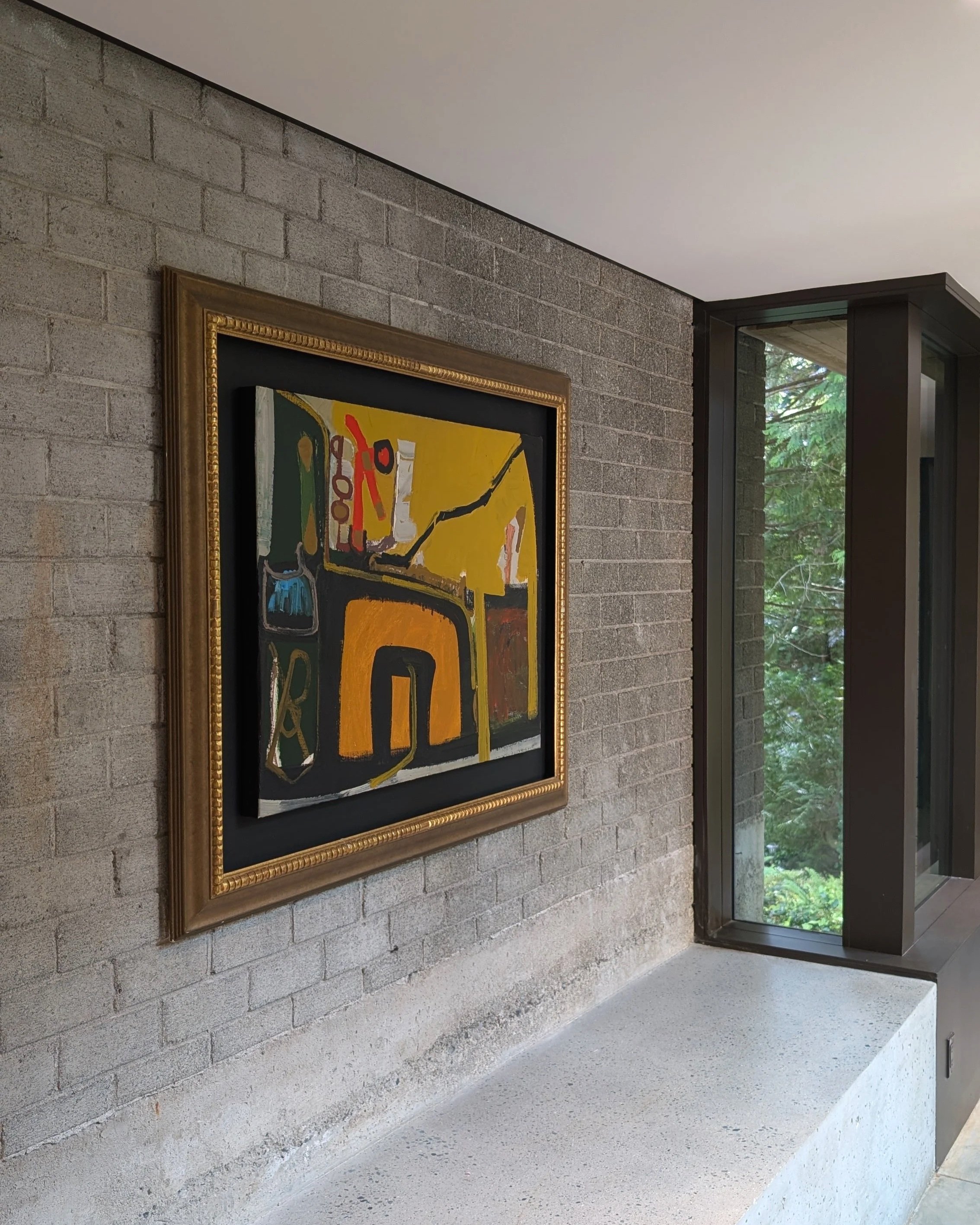
Executed in 1956, WALL JUMPING is a monumental and historically significant masterwork created during the absolute zenith of Harold Town’s career. 1956 was a watershed year for both Town and Canadian modernism: it was the year Town represented Canada at the XXVIII Venice Biennale and co-led the groundbreaking exhibition of Painters Eleven at the American Abstract Artists show in New York.

In WALL JUMPING, heavy black and forest-green structural lines slice across the composition, creating an architectonic frame that holds intense, vibrating fields of mustard yellow, burnt orange, and crimson. Town bridges the spontaneous, raw energy of Action Painting with the precise graphic structure derived from his background as a master illustrator.

Technically, the painting highlights Town’s restless innovation as a materialist. Rather than using conventional oil alone, Town combined oil paint with Lucite 44, an early acrylic resin developed by DuPont, applying it directly to a custom lead-zinc primed Masonite panel. This pioneering technique allowed Town to build lush, enamel-like glosses, impasto textures, and razor-sharp linear definition that remain remarkably vibrant nearly seven decades later.

Artist Biography

Co-founder of the historic Painters Eleven collective (1953–1960), and the person who famously named the group, Harold Town was a charismatic force who transformed Western Canada's reception of non-objective art. Dubbed the "Picasso of Canada" for his staggering aesthetic range across painting, collage, printmaking, and sculpture, Town rejected the dominant landscape traditions of his era to champion a bold, uncompromising Abstract Expressionism.

In addition to representing Canada twice at the Venice Biennale (1956, 1964) and at the São Paulo Bienal (1957, 1961), Town was lauded by Alfred Barr, legendary founding director of MoMA, as one of the world’s greatest printmakers. Appointed an Officer of the Order of Canada in 1968, Town remains one of the most vital, celebrated figures in 20th-century North American art history.

Major Accolades & Recognition

  • Appointed Officer of the Order of Canada (O.C., 1968)

  • Representative for Canada at the XXVIII & XXXII Venice Bienniales (1956, 1964)

  • Representative for Canada at the São Paulo Bienal (1957 - Arno Award Winner, 1961)

  • Exhibited at documenta III, Kassel, West Germany (1964)

  • Co-Founder and Nametag Creator, Painters Eleven (1953)

  • Retrospective Exhibitions at the Art Gallery of Ontario (1986), Art Gallery of Windsor (1975), and Robert McLaughlin Gallery (1979)

Selected Permanent Collections

  • The Museum of Modern Art / MoMA (New York, NY)

  • Solomon R. Guggenheim Museum (New York, NY)

  • Tate Gallery (London, UK)

  • Hirshhorn Museum and Sculpture Garden (Washington, D.C.)

  • National Gallery of Canada (Ottawa, ON)

  • Art Gallery of Ontario / AGO (Toronto, ON)

  • Musée d'art contemporain de Montréal / MACM (Montreal, QC)

  • Vancouver Art Gallery (Vancouver, BC)

Harold Barling Town
(Canadian, 1924–1990)
WALL JUMPING
1956
Oil and Lucite 44 on lead-zinc Masonite panel
Signed, dated, and inscribed on the reverse: "Town '56, Wall Jumping, HT-P134-0, oil and lucite 44 on lead zinc masonite panel"
Panel: 54.5 × 43.5 in. (138.4 × 110.5 cm)

Provenance:
The Estate of Harold Town, Toronto
Sotheby's Toronto, Important Canadian Art, December 3, 2009, Lot 120

Description & Historical Significance

Executed in 1956, WALL JUMPING is a monumental and historically significant masterwork created during the absolute zenith of Harold Town’s career. 1956 was a watershed year for both Town and Canadian modernism: it was the year Town represented Canada at the XXVIII Venice Biennale and co-led the groundbreaking exhibition of Painters Eleven at the American Abstract Artists show in New York.

In WALL JUMPING, heavy black and forest-green structural lines slice across the composition, creating an architectonic frame that holds intense, vibrating fields of mustard yellow, burnt orange, and crimson. Town bridges the spontaneous, raw energy of Action Painting with the precise graphic structure derived from his background as a master illustrator.

Technically, the painting highlights Town’s restless innovation as a materialist. Rather than using conventional oil alone, Town combined oil paint with Lucite 44, an early acrylic resin developed by DuPont, applying it directly to a custom lead-zinc primed Masonite panel. This pioneering technique allowed Town to build lush, enamel-like glosses, impasto textures, and razor-sharp linear definition that remain remarkably vibrant nearly seven decades later.

Artist Biography

Co-founder of the historic Painters Eleven collective (1953–1960), and the person who famously named the group, Harold Town was a charismatic force who transformed Western Canada's reception of non-objective art. Dubbed the "Picasso of Canada" for his staggering aesthetic range across painting, collage, printmaking, and sculpture, Town rejected the dominant landscape traditions of his era to champion a bold, uncompromising Abstract Expressionism.

In addition to representing Canada twice at the Venice Biennale (1956, 1964) and at the São Paulo Bienal (1957, 1961), Town was lauded by Alfred Barr, legendary founding director of MoMA, as one of the world’s greatest printmakers. Appointed an Officer of the Order of Canada in 1968, Town remains one of the most vital, celebrated figures in 20th-century North American art history.

Major Accolades & Recognition

  • Appointed Officer of the Order of Canada (O.C., 1968)

  • Representative for Canada at the XXVIII & XXXII Venice Bienniales (1956, 1964)

  • Representative for Canada at the São Paulo Bienal (1957 - Arno Award Winner, 1961)

  • Exhibited at documenta III, Kassel, West Germany (1964)

  • Co-Founder and Nametag Creator, Painters Eleven (1953)

  • Retrospective Exhibitions at the Art Gallery of Ontario (1986), Art Gallery of Windsor (1975), and Robert McLaughlin Gallery (1979)

Selected Permanent Collections

  • The Museum of Modern Art / MoMA (New York, NY)

  • Solomon R. Guggenheim Museum (New York, NY)

  • Tate Gallery (London, UK)

  • Hirshhorn Museum and Sculpture Garden (Washington, D.C.)

  • National Gallery of Canada (Ottawa, ON)

  • Art Gallery of Ontario / AGO (Toronto, ON)

  • Musée d'art contemporain de Montréal / MACM (Montreal, QC)

  • Vancouver Art Gallery (Vancouver, BC)

Harold Town (1924-1990), a celebrated figure in Canadian art, was distinguished not only for his remarkable artistic talent but also for his vibrant personality and unconventional lifestyle. A co-founder of Painters Eleven, a significant artists' group from Toronto, Town was instrumental in mainstreaming the abstract painting style popular in New York into Canadian art in the 1950s. This group, formed in 1953 by young artists including Jack Bush, Oscar Cahén, and William Ronald, played a crucial role in exhibiting abstract art in Toronto.

Born in Toronto, the son of a railway conductor, Town's deep engagement with drawing began in his youth. His education at Western Technical-Commercial School and the Ontario College of Art, along with his exposure to art history and the Old Masters, profoundly shaped his artistic approach. His career was marked by a versatility across various media such as painting, drawing, prints, collage, and assembly, each showcasing his distinct creativity and technical expertise.

Town's artistic achievements were globally recognized, notably with his works being exhibited at the Venice Biennale in both 1956 and 1964. His "single autographic prints" garnered international acclaim, leading to their inclusion in prestigious collections like the Guggenheim and the Museum of Modern Art in New York.

His career was further highlighted by numerous accolades. In 1957, Town received the Arno Award at the Biennale de São Paulo, affirming his stature on the international stage. This recognition was followed by a series of honors, including an Honorary Doctorate from York University in 1966 and an appointment as an Officer of the Order of Canada in 1968, solidifying his position as a leading figure in Canadian art. His memberships in esteemed societies such as the Canadian Group of Painters and the Royal Canadian Academy of Arts underscored his influential role within the art community.

Town's work is represented in a wide array of esteemed collections worldwide. These include the Stedelijk Museum in Amsterdam, the Tate Gallery in London, the Metropolitan Museum of Art in New York, the Edmonton Art Gallery, the Beaverbrook Art Gallery, the Art Gallery of Hamilton, the Agnes Etherington Art Centre at Queen’s University, and the National Gallery of Canada, among others, reflecting the extensive reach and appeal of his art.

Throughout his life, Town engaged in numerous public art commissions and took part in significant exhibitions across Canada, the United States, Europe, South America, and Japan. His art, characterized by a profound love of color, energy, and dramatic intensity, mirrored his diverse interests and inspirations. His success, marked by record prices for his works and his prominence as a cultural icon, played a vital role in elevating the Canadian art scene to new levels of confidence and sophistication.