Image 1 of 5
 Image 2 of 5
 Image 3 of 5
 Image 4 of 5
 Image 5 of 5
Herbert Johannes Josef Siebner
(Canadian/German, 1925–2003)
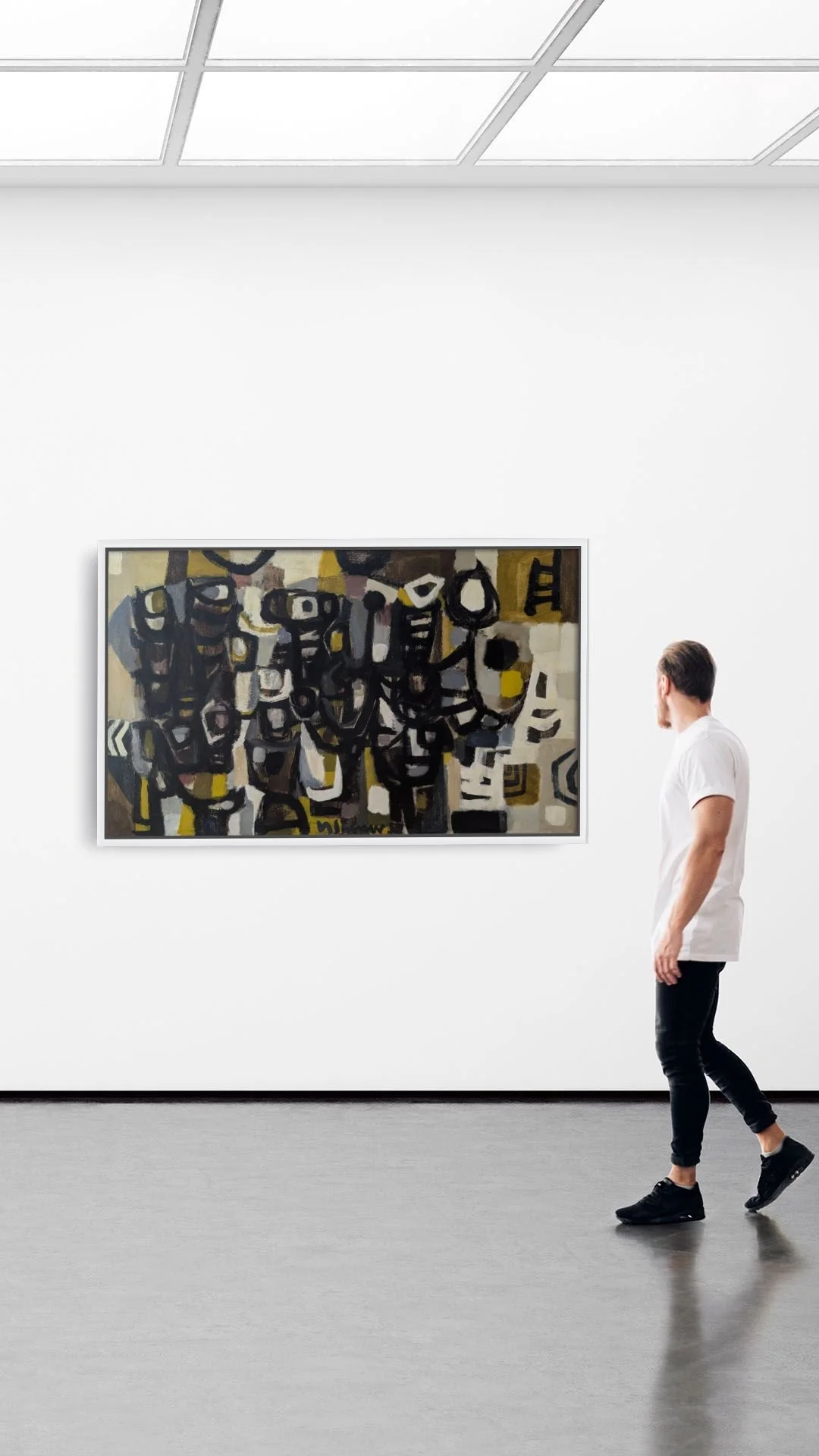
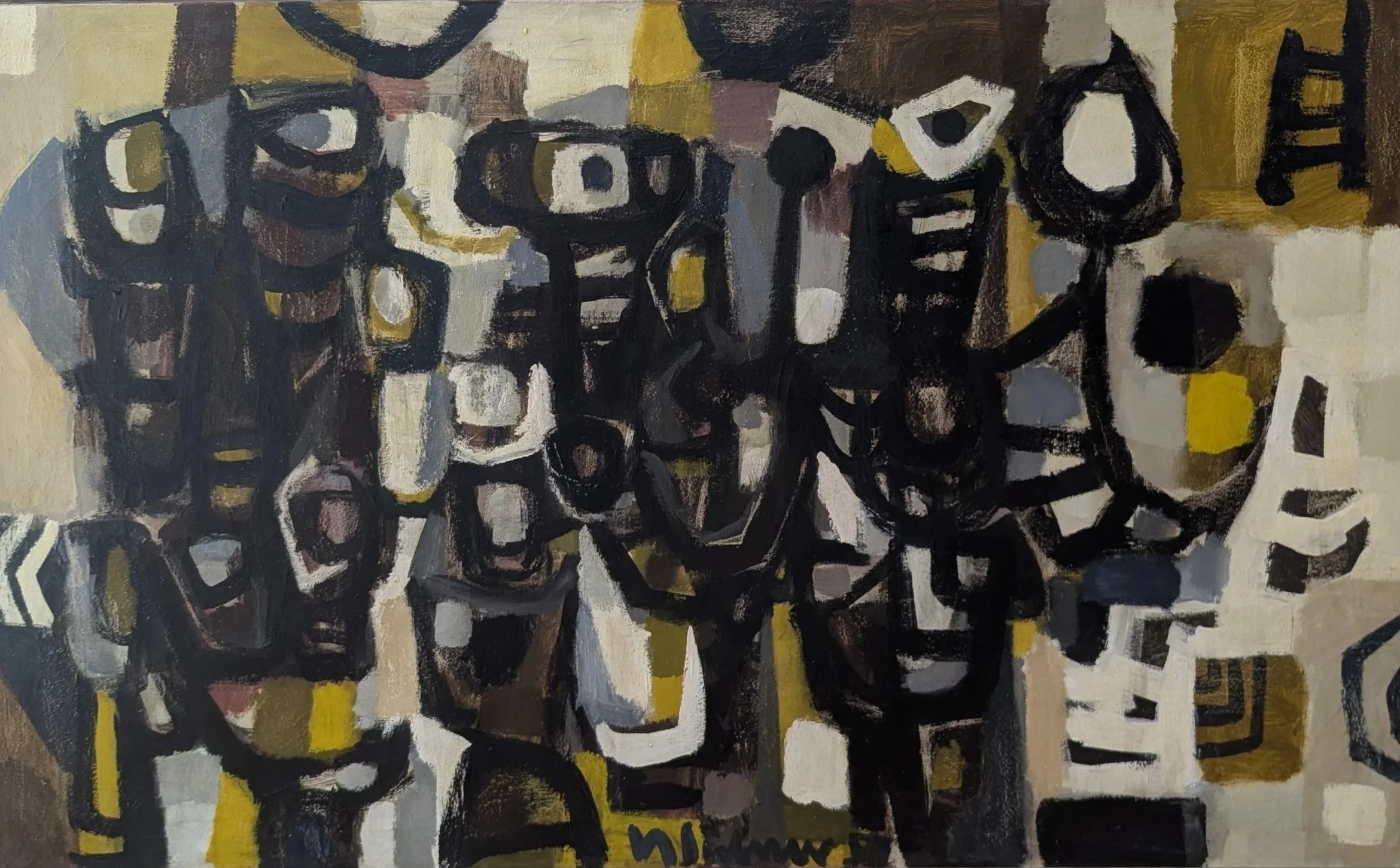
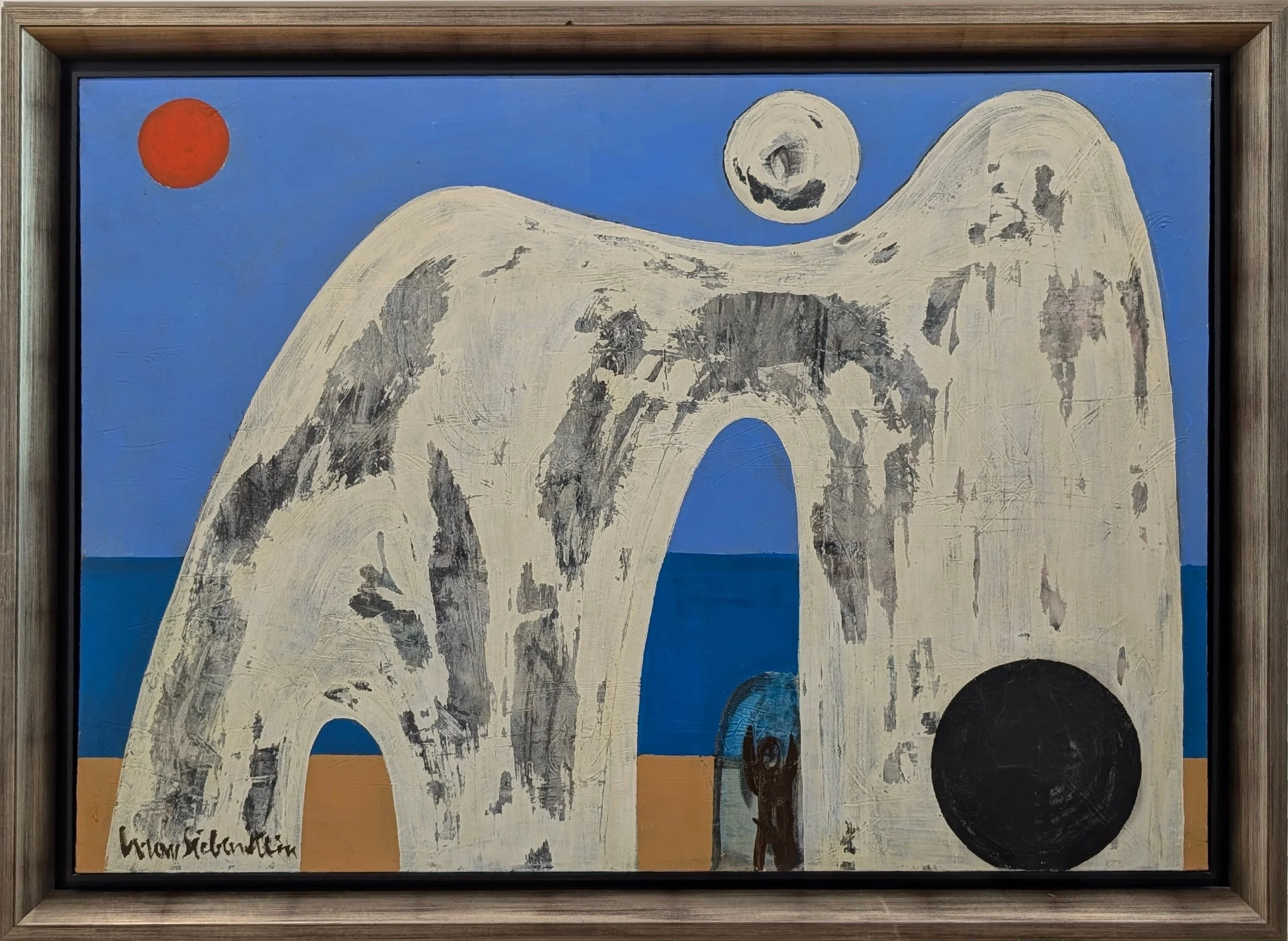
Stone Head
1956
Oil on board
Signed and dated "Siebner 56" lower left
Frame: 29.75 × 33.25 in. (75.6 × 84.5 cm)
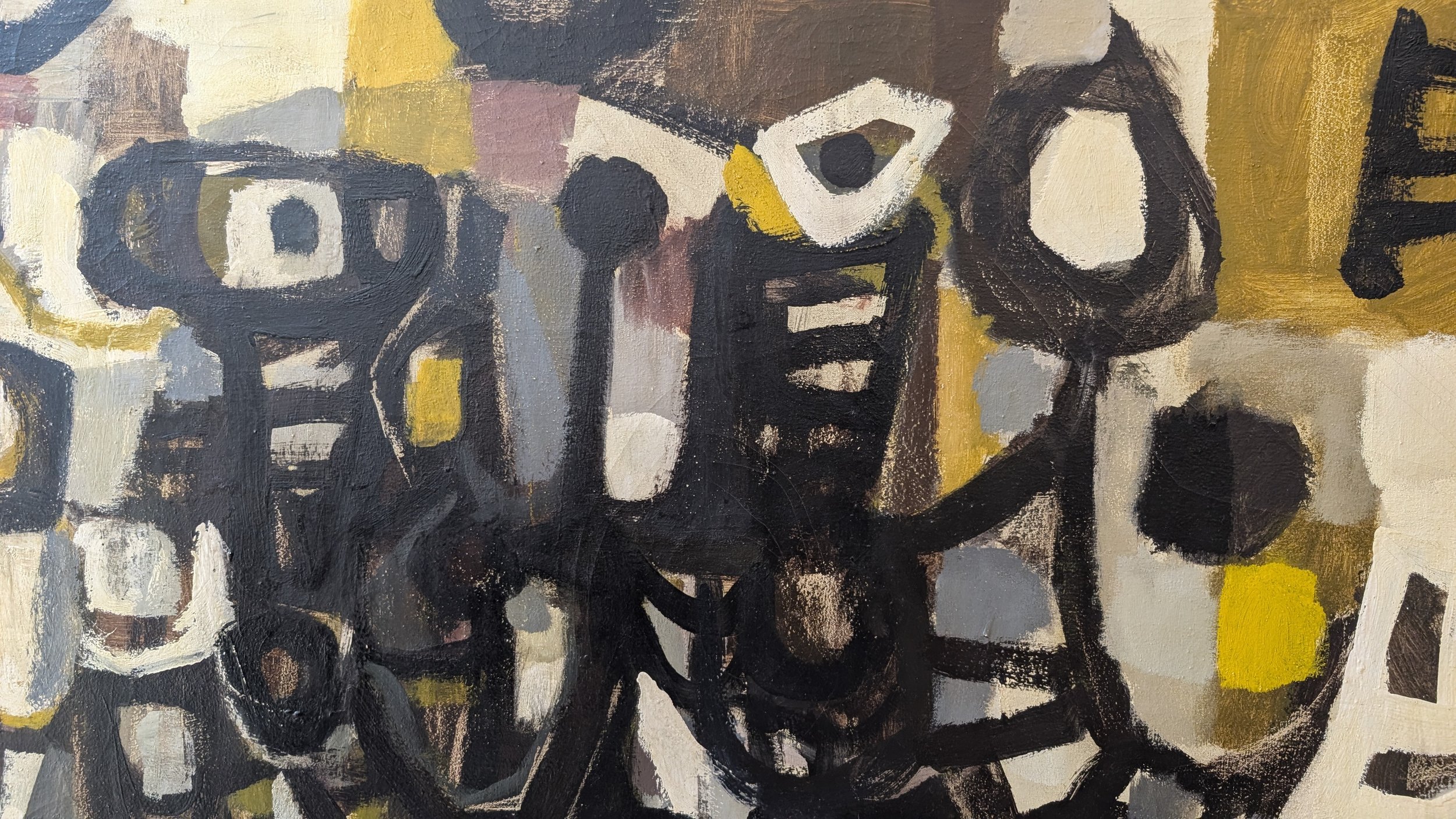
Executed in 1956, Stone Head is a rare and historically significant early Canadian work by Herbert Siebner, created just two years after his arrival in Victoria from Berlin. The composition transforms the human face into an architectural, carved monument. Set against stark black shadows and cool bone-grey planes, a single stylized eye gazes outward from a textured terracotta field. This work highlights Siebner's mastery of sculptural mass and primal mask iconography, directly bridging post-war European avant-garde aesthetics with mid-century Canadian modernism.
1956 was a watershed year in Siebner's career, marking the exact moment he was awarded the Canadian National Award in Graphic Arts and established himself as a dominant new voice in West Coast art. The faceted, chiseled quality of Stone Head reflects his concurrent explorations in printmaking and stone carving, drawing inspiration from ancient archetypes and European Cubism. Presented in a commanding period frame with a deep linen mat, this 1956 painting is a pristine example of his most sought-after early period.
Arriving in Victoria in 1954 after studying under Max Pechstein at the Academy of Fine Arts in Berlin, Siebner is widely credited with helping introduce German Expressionism to Western Canada. In 1971, he co-founded the legendary Victoria Limners Society alongside Maxwell Bates, Myfanwy Pavelic, Karl Spreitz, and Elza Mayhew, creating a vital bohemian collective that transformed the regional art scene. Over his five-decade career, Siebner held more than 130 solo exhibitions across North America and Europe.
Major Accolades & Recognition:
Recipient, Canadian National Award in Graphic Arts (1956)
Held over 130 solo exhibitions worldwide during his lifetime
Elected Member, Royal Canadian Academy of Arts (R.C.A., 1973)
Co-Founder and President, The Victoria Limners Society (1971)
Recipient, Canada Council Senior Arts Fellowship Grant (1962)
Canadian Centennial Medal Recipient (1967)
Retrospective & Solo Exhibitions, Art Gallery of Greater Victoria (1955, 1961, 1965, 1970, 1984, 2003)
Selected Permanent Collections:
National Gallery of Canada (Ottawa, ON)
Vancouver Art Gallery (Vancouver, BC)
Art Gallery of Greater Victoria (Victoria, BC)
Royal Ontario Museum (Toronto, ON)
Collection of Princess Fernanda von Thurn und Taxis
City of Berlin Collection (Berlin, Germany)
Confederation Centre Art Gallery (Charlottetown, PEI)
Seattle Art Museum (Seattle, WA)
University of Victoria Archives & Special Collections (Victoria, BC)
Feckless Collection (Vancouver, BC)
Herbert Johannes Josef Siebner
(Canadian/German, 1925–2003)
Stone Head
1956
Oil on board
Signed and dated "Siebner 56" lower left
Frame: 29.75 × 33.25 in. (75.6 × 84.5 cm)
Executed in 1956, Stone Head is a rare and historically significant early Canadian work by Herbert Siebner, created just two years after his arrival in Victoria from Berlin. The composition transforms the human face into an architectural, carved monument. Set against stark black shadows and cool bone-grey planes, a single stylized eye gazes outward from a textured terracotta field. This work highlights Siebner's mastery of sculptural mass and primal mask iconography, directly bridging post-war European avant-garde aesthetics with mid-century Canadian modernism.
1956 was a watershed year in Siebner's career, marking the exact moment he was awarded the Canadian National Award in Graphic Arts and established himself as a dominant new voice in West Coast art. The faceted, chiseled quality of Stone Head reflects his concurrent explorations in printmaking and stone carving, drawing inspiration from ancient archetypes and European Cubism. Presented in a commanding period frame with a deep linen mat, this 1956 painting is a pristine example of his most sought-after early period.
Arriving in Victoria in 1954 after studying under Max Pechstein at the Academy of Fine Arts in Berlin, Siebner is widely credited with helping introduce German Expressionism to Western Canada. In 1971, he co-founded the legendary Victoria Limners Society alongside Maxwell Bates, Myfanwy Pavelic, Karl Spreitz, and Elza Mayhew, creating a vital bohemian collective that transformed the regional art scene. Over his five-decade career, Siebner held more than 130 solo exhibitions across North America and Europe.
Major Accolades & Recognition:
Recipient, Canadian National Award in Graphic Arts (1956)
Held over 130 solo exhibitions worldwide during his lifetime
Elected Member, Royal Canadian Academy of Arts (R.C.A., 1973)
Co-Founder and President, The Victoria Limners Society (1971)
Recipient, Canada Council Senior Arts Fellowship Grant (1962)
Canadian Centennial Medal Recipient (1967)
Retrospective & Solo Exhibitions, Art Gallery of Greater Victoria (1955, 1961, 1965, 1970, 1984, 2003)
Selected Permanent Collections:
National Gallery of Canada (Ottawa, ON)
Vancouver Art Gallery (Vancouver, BC)
Art Gallery of Greater Victoria (Victoria, BC)
Royal Ontario Museum (Toronto, ON)
Collection of Princess Fernanda von Thurn und Taxis
City of Berlin Collection (Berlin, Germany)
Confederation Centre Art Gallery (Charlottetown, PEI)
Seattle Art Museum (Seattle, WA)
University of Victoria Archives & Special Collections (Victoria, BC)
Feckless Collection (Vancouver, BC)