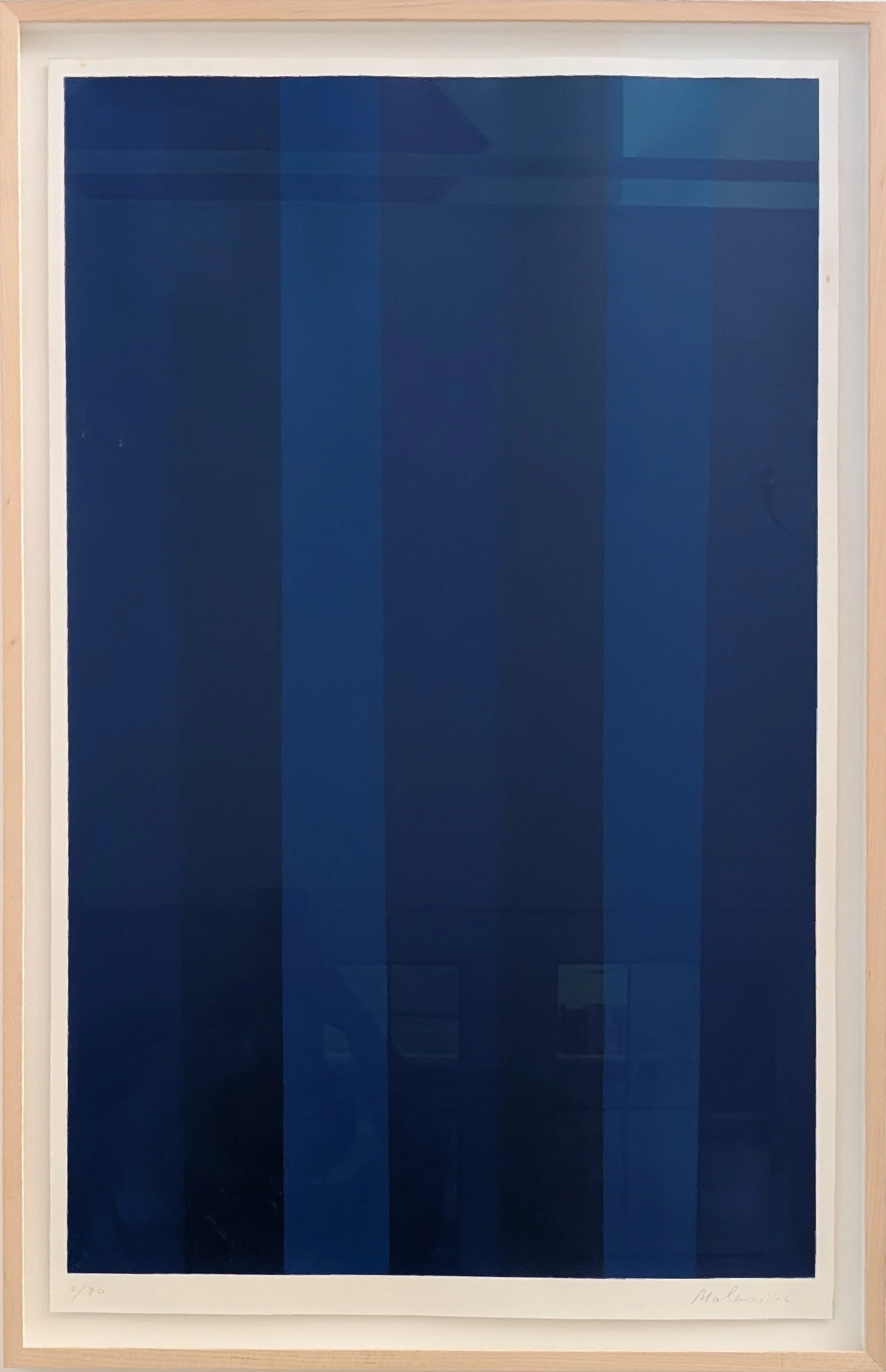
Guido Molinari

$27,500.00
SOLD

Guido Molinari
(Canadian, 1933–2004)
DIX NOIR BLANC (Suite of Four)
1956/57
Set of four signed serigraphs on paper
Signed, dated, and numbered from the edition of 90 in pencil
Frame (each): 31.5 × 41 × 2 in. (80.0 × 104.1 × 5.1 cm)

Conceived during the seminal 1956–1957 period of Guido Molinari's career, DIX NOIR BLANC is widely recognized as a cornerstone portfolio of Canadian Hard-Edge Abstraction and the Les Plasticiens movement. Presented here as a commanding, uniformly framed suite of four serigraphs from the total portfolio of ten, each work presents a stark, minimalist dialogue between solid black geometric masses and pristine white negative space. Through precise spatial arrangements, Molinari achieves total figure-ground reversibility, forcing the viewer's eye to actively navigate the perceptual rhythm and optical tension between positive shape and surrounding space.

Created in the immediate wake of Molinari's radical 1956 black-and-white exhibition at Galerie L'Actuelle in Montreal, DIX NOIR BLANC stands as the definitive print manifesto of his early structural theories. By stripping away all color and gestural brushwork, Molinari challenged the dominant emotional expressionism of the era in favor of pure, autonomous optical rhythm. The historic importance of this series is underscored by the fact that the complete portfolio of all ten prints is preserved in the permanent collection of the National Gallery of Canada. Displayed together as a matching set of four, these large-scale framed works form an authoritative installation that exemplifies the birth of hard-edge modernism in Canada.

Born in Montreal, Guido Molinari was a titan of 20th-century Canadian modernism and a primary architect of the Les Plasticiens movement. He achieved international renown for his relentless investigations into color theory, perception, and non-figurative space. In 1968, Molinari represented Canada at the 34th Venice Biennale, where he was awarded the prestigious David E. Bright Foundation prize. Appointed an Officer of the Order of Canada in 1971 and the youngest-ever recipient of Quebec's Prix Paul-Émile-Borduas in 1980, Molinari's legacy as a painter, theorist, and educator at Concordia University remains central to the history of Western abstraction.

Major Accolades & Recognition:

  • Portfolio DIX NOIR BLANC held in the Permanent Collection of the National Gallery of Canada

  • Winner, Prix Paul-Émile-Borduas (1980)

  • Appointed Officer of the Order of Canada (O.C., 1971)

  • Recipient, David E. Bright Foundation Prize, Venice Biennale (1968)

  • Representative for Canada at the 34th Venice Biennale (1968)

  • Included in the landmark exhibition The Responsive Eye, MoMA, New York (1965)

  • Recipient, John Simon Guggenheim Memorial Foundation Fellowship (1967)

  • Co-Founder, Galerie L'Actuelle, Montreal (1955)

Selected Permanent Collections:

  • National Gallery of Canada (Ottawa, ON)

  • The Museum of Modern Art / MoMA (New York, NY)

  • Solomon R. Guggenheim Museum (New York, NY)

  • Musée d'art contemporain de Montréal / MACM (Montreal, QC)

  • Musée des beaux-arts de Montréal / MMFA (Montreal, QC)

  • Art Gallery of Ontario / AGO (Toronto, ON)

  • Vancouver Art Gallery (Vancouver, BC)

  • Fondation Guido Molinari (Montreal, QC)

Guido Molinari
(Canadian, 1933–2004)
DIX NOIR BLANC (Suite of Four)
1956/57
Set of four signed serigraphs on paper
Signed, dated, and numbered from the edition of 90 in pencil
Frame (each): 31.5 × 41 × 2 in. (80.0 × 104.1 × 5.1 cm)

Conceived during the seminal 1956–1957 period of Guido Molinari's career, DIX NOIR BLANC is widely recognized as a cornerstone portfolio of Canadian Hard-Edge Abstraction and the Les Plasticiens movement. Presented here as a commanding, uniformly framed suite of four serigraphs from the total portfolio of ten, each work presents a stark, minimalist dialogue between solid black geometric masses and pristine white negative space. Through precise spatial arrangements, Molinari achieves total figure-ground reversibility, forcing the viewer's eye to actively navigate the perceptual rhythm and optical tension between positive shape and surrounding space.

Created in the immediate wake of Molinari's radical 1956 black-and-white exhibition at Galerie L'Actuelle in Montreal, DIX NOIR BLANC stands as the definitive print manifesto of his early structural theories. By stripping away all color and gestural brushwork, Molinari challenged the dominant emotional expressionism of the era in favor of pure, autonomous optical rhythm. The historic importance of this series is underscored by the fact that the complete portfolio of all ten prints is preserved in the permanent collection of the National Gallery of Canada. Displayed together as a matching set of four, these large-scale framed works form an authoritative installation that exemplifies the birth of hard-edge modernism in Canada.

Born in Montreal, Guido Molinari was a titan of 20th-century Canadian modernism and a primary architect of the Les Plasticiens movement. He achieved international renown for his relentless investigations into color theory, perception, and non-figurative space. In 1968, Molinari represented Canada at the 34th Venice Biennale, where he was awarded the prestigious David E. Bright Foundation prize. Appointed an Officer of the Order of Canada in 1971 and the youngest-ever recipient of Quebec's Prix Paul-Émile-Borduas in 1980, Molinari's legacy as a painter, theorist, and educator at Concordia University remains central to the history of Western abstraction.

Major Accolades & Recognition:

  • Portfolio DIX NOIR BLANC held in the Permanent Collection of the National Gallery of Canada

  • Winner, Prix Paul-Émile-Borduas (1980)

  • Appointed Officer of the Order of Canada (O.C., 1971)

  • Recipient, David E. Bright Foundation Prize, Venice Biennale (1968)

  • Representative for Canada at the 34th Venice Biennale (1968)

  • Included in the landmark exhibition The Responsive Eye, MoMA, New York (1965)

  • Recipient, John Simon Guggenheim Memorial Foundation Fellowship (1967)

  • Co-Founder, Galerie L'Actuelle, Montreal (1955)

Selected Permanent Collections:

  • National Gallery of Canada (Ottawa, ON)

  • The Museum of Modern Art / MoMA (New York, NY)

  • Solomon R. Guggenheim Museum (New York, NY)

  • Musée d'art contemporain de Montréal / MACM (Montreal, QC)

  • Musée des beaux-arts de Montréal / MMFA (Montreal, QC)

  • Art Gallery of Ontario / AGO (Toronto, ON)

  • Vancouver Art Gallery (Vancouver, BC)

  • Fondation Guido Molinari (Montreal, QC)

ADDITION proudly presents four signed serigraphs from Guido Molinari's DIX NOIR BLANC series, produced between 1956-1967. These pivotal works, part of a series of ten housed in the National Gallery of Canada, exemplify Molinari's mastery in monochromatic art and his profound influence on Canadian art history.

Appointed an Officer of the Order of Canada in 1971, Molinari's contributions to the nation are immense. Influenced by Barnett Newman and Jackson Pollock, his involvement in the Plasticiens movement signified a significant shift in Montreal's art scene, transitioning from abstract expressionism to post-painterly abstraction, thus fostering a unique modernist practice distinct from New York’s art scene.

Molinari's career is marked by numerous accolades, including the Jessie Dow award from The Montreal Museum of Fine Arts (1962), The Royal Canadian Academy of Art Award (1965), The Guggenheim Fellowship (1967), The David E. Bright Foundation Award at the 34th Venice Biennale (1968), and the Prix Paul-Émile-Borduas (1980). His global presence is affirmed by his participation in The Responsive Eye at MoMA (1965), the Venice Biennale (1968), and the Paris Biennale (1977).

A revered teacher, Molinari influenced generations of artists during his nearly three-decade tenure at Sir George Williams University and Concordia University, retiring in 1997. His theoretical writings and strong opinions have left a lasting mark on the art community.

Celebrated in the Guggenheim, MoMA, and through retrospectives at the National Gallery of Canada (1976) and the Musée d’art contemporain de Montréal (1995), Molinari's legacy is a testament to his innovative vision and enduring impact.